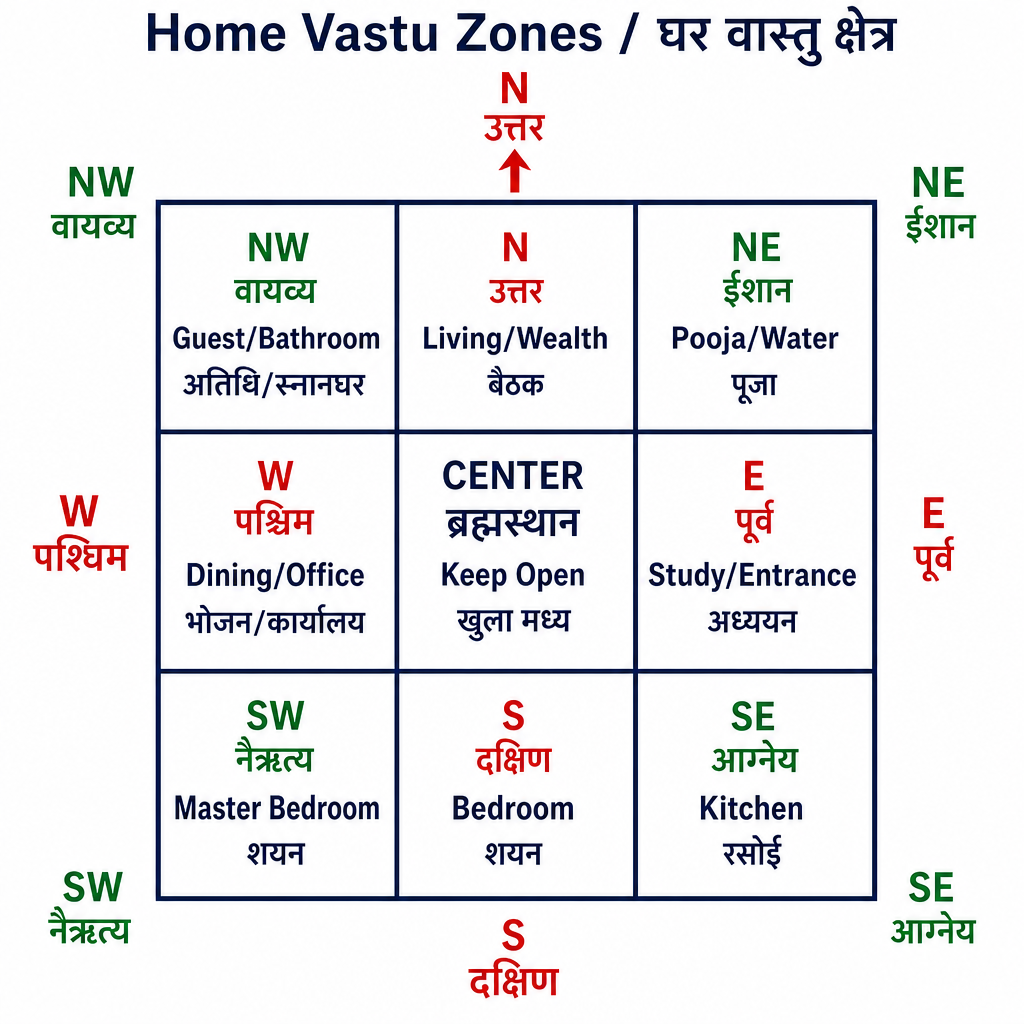
Ghar vastu is fundamentally about light, air, heat, drainage, and movement. The classical directional rules encode a practical logic for the Indian climate: morning sun into the living areas, heat sources in the south-east, heavy storage in the south-west, water in the north-east. Understanding that logic is more useful than memorising a list of prohibitions.
The audit is guidance for planning and small adjustments, not a structural verdict and not a reason for panic or demolition. It is not engineering, legal, or financial advice. Most reported issues have low-cost mitigations, and no vastu report should be used to pressure a family into expensive rebuilding.
How the eight directions are used
Vastu divides a plot into eight directions plus the centre, and assigns a functional character to each. North-east is associated with water and worship, south-east with fire and cooking, south-west with weight and stability, and north-west with movement and storage of things that leave the house.
The centre, or brahmasthan, is traditionally kept open and unburdened. A staircase, heavy pillar, or toilet in the exact centre is the item most classical texts treat as significant, which is why the audit asks about it specifically.
Each direction check produces a plain statement: aligned, acceptable, or worth adjusting. The audit explains the reasoning so you can judge whether a reported mismatch actually affects how your household lives.
One clarification worth making: this audit is compass-based, not chart-based. It does not use your birth details, and no ayanamsa — Lahiri or otherwise — enters the calculation, because vastu measures the orientation of a building rather than the sidereal position of a planet.
What the audit asks you and why
Entrance facing sets the frame for everything else, so give it as accurately as you can — a compass or phone compass reading taken standing inside the door and looking out is enough. Approximate facing produces approximate results.
Kitchen placement is asked because the fire element is directionally sensitive in classical practice, with the south-east considered ideal and the north-east least suitable. Toilet and drainage placement is asked for the same reason in reverse.
Bedroom, staircase, water storage, and puja space complete the picture. If you do not know a placement, leave it out rather than guessing; the report will simply cover less ground instead of giving you a confident answer built on invented data.
Practical mitigation before renovation
Most vastu mismatches in an existing home can be softened rather than rebuilt. Improving light and ventilation in a heavy corner, clearing clutter from the brahmasthan, relocating a bed or study desk, and fixing leaks and drainage address a large share of reported issues.
Colour, mirror placement, and the use of metals or plants are commonly suggested adjustments. Treat them as supportive habits rather than mechanical fixes, and give a change a few weeks before deciding whether it helped.
Structural change should be the last resort, considered only with a qualified architect or civil engineer and never on the basis of a web report alone. A vastu audit can tell you what tradition prefers; it cannot tell you what your building can safely take.
Worked example: a north-east kitchen
Suppose a flat faces east, the kitchen sits in the north-east corner, the master bedroom is in the south-west, and the toilet is in the north-west. The audit would report the bedroom and toilet as reasonably aligned and flag the kitchen, because the fire element in the water-associated north-east is the classical mismatch here.
The practical reading is not that the family must move the kitchen. It is that this corner will run hot and may feel cluttered, so the sensible steps are strong exhaust ventilation, keeping the cooking platform tidy, avoiding heavy storage stacked in that corner, and shifting the water source within the kitchen if the plumbing allows.
If the family later renovates for other reasons, that is the moment to reconsider the kitchen position with an architect. Until then, the audit has done its job: it named the tension, explained the reasoning, and offered adjustments that cost very little.
Honest limits and next steps
The audit works from the placements you describe, so it cannot see slope, neighbouring structures, the actual sun path onto your windows, road level, or soil conditions. A site visit by an experienced practitioner sees all of that and this form does not.
Vastu is a design tradition, not a guarantee. No layout causes or cures illness, unemployment, or family conflict on its own, and this report should never be read as medical, legal, or financial advice.
For a focused check, use the Vastu Entrance Checker for main door direction or the Vastu Room Checker for a single room. If the underlying worry is a chart-based one, Dosha Checker and Vedic Upaay are the better places to look.